¶ 2.2 · Limit laws and indeterminate forms
فارسی · Curriculum · Week 6 guide · Course index
¶ Learning goals
Use limit laws with their hypotheses, simplify an expression near a missing point, and decide whether separate one-sided limits agree. By the end, you should be able to explain why a cancellation preserves nearby values even when it changes the domain of the simplified formula.
¶ Start with the denominator
A limit describes values arbitrarily close to the target. If two formulas agree for every nearby input other than the target, their limits agree. A value assigned at the target can differ from that limit.
For finite limits L and M, the sum tends to L + M, a constant multiple tends to cL, the product tends to LM, and a positive integer power tends to the corresponding power of L. The quotient tends to L/M when M ≠ 0. These rules build direct substitution for polynomials and for rational expressions whose denominators remain nonzero at the target. For square roots use the real domain and the fact that √u approaches √L as u approaches L ≥ 0 through nonnegative values. The product rule makes sense because the factors become arbitrarily close to L and M and stay bounded near the target. A nonzero denominator limit likewise keeps the denominator bounded away from zero close enough to the target.
If direct substitution produces 0/0, you have found an indeterminate form. Different functions with that form can tend to different numbers or have no two-sided limit. Look for an identity valid off the target, then check the new denominator or compute each side. A graph or table can test your prediction. A table of finite samples cannot establish a limit by itself.
¶ Four worked examples
¶ 1 · A safe quotient
Evaluate (2x² − x + 3)/(x + 2) as x → 1. The power and sum laws give numerator 2 − 1 + 3 = 4 and denominator 3. Since 3 ≠ 0, the quotient law gives 4/3. Check nearby values by substituting 0.99 and 1.01. The slight variation is expected because this rule evaluates a limit, while each sample still has a different input.
¶ 2 · A removable hole
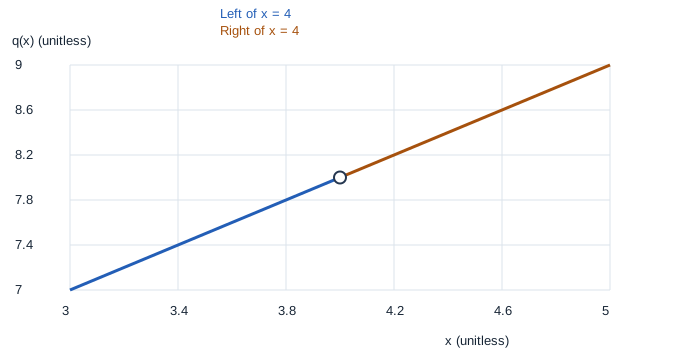
For q(x) = (x² − 16)/(x − 4), substitution at 4 gives 0/0. Factor the numerator as (x − 4)(x + 4). Cancel for x ≠ 4, giving q(x) = x + 4 on both sides. The limit is 8. The original q is still undefined at 4. If a new function assigns q(4) = 12, the limit is still 8 because none of the surrounding values changed. At x = 3.99 and 4.01, the samples are 7.99 and 8.01.
¶ 3 · A conjugate
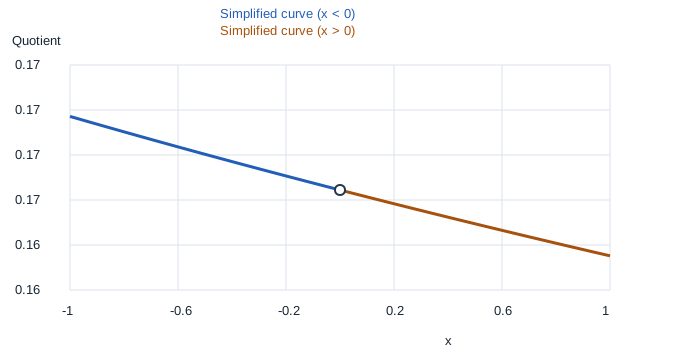
Evaluate (√(x + 9) − 3)/x as x → 0. The numerator is a difference of roots with a small value near zero. Multiply numerator and denominator by √(x + 9) + 3. The numerator becomes (x + 9) − 9 = x. For nearby x ≠ 0 the expression is 1/(√(x + 9) + 3), so the limit is 1/6. Both sides are available because x + 9 is positive near 0. This also avoids subtracting nearly equal numbers when sampling with a calculator.
¶ 4 · Check the two sides
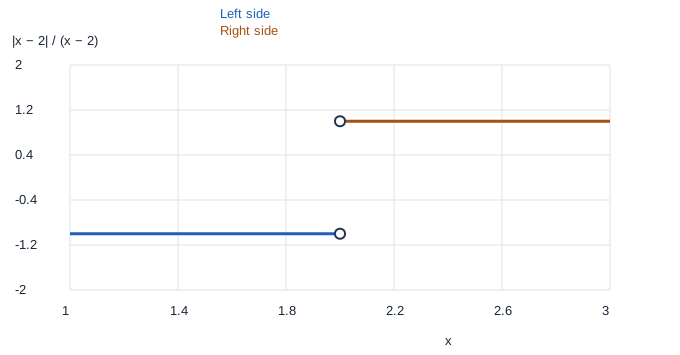
For |x − 2|/(x − 2) as x → 2, substitute the sign-dependent formula. On the left |x − 2| = −(x − 2), so the quotient is −1. On the right it is +1. Since these one-sided limits disagree, the two-sided limit does not exist. An assigned value at x = 2 would leave this disagreement intact.
¶ Check your reasoning
Write the restriction beside each canceled factor. If you see 0/0, state which transformation you will try and why it preserves nearby values. With absolute values or piecewise formulas, write a separate rule for each side. As an optional preview, the squeeze theorem gives a limit when a function is trapped between two bounds with the same limit. For example, −x² ≤ x² sin(1/x) ≤ x² near 0, so the middle tends to 0 even though the sine alone oscillates. The lab focuses on the algebraic methods.
¶ Practice and worked answers
- Find the limit of 3x² − 5x + 1 at x = 2. Answer: Apply the polynomial rules to get 12 − 10 + 1 = 3.
- Evaluate (x² + 1)/(2x + 1) as x → 1. Answer: The denominator tends to 3, so the quotient tends to 2/3.
- Evaluate (x² − 25)/(x − 5) as x → 5. State the original domain restriction. Answer: Factor to (x − 5)(x + 5), then divide for x ≠ 5. The limit is 10 and 5 is excluded.
- Evaluate (√(x + 4) − 2)/x as x → 0. Answer: Multiply by the conjugate and cancel x for x ≠ 0. The remaining reciprocal tends to 1/(2 + 2) = 1/4.
- Evaluate (x + 1)/|x + 1| at x → −1. Answer: Its left and right limits are −1 and +1, respectively. There is no two-sided limit.
- Let p(x) = (x² − 9)/(x − 3) for x ≠ 3 and p(3) = 10. Find the limit and value. Answer: The neighboring formula is x + 3, so the limit is 6. The assigned value is 10.
- Evaluate (x − 1)²/(x − 1) as x → 1. Answer: It reduces to x − 1 only for x ≠ 1. That tends to 0, showing that a 0/0 form can have a zero limit.
- Use bounds to evaluate x³ cos(1/x) as x → 0. Answer: Its magnitude is at most |x|³, which tends to 0. The expression is squeezed to 0.